Entry into ‘Poser’

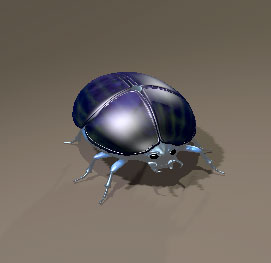
Scarab in Poser

My first foray into using Poser, which is an application with 3D models and character creation tools to create and render 3D graphics and animations. The manual is 800+ pages so I am ignoring that and jumping in to play. Luckily there is a scarab beetle in the library so I will use this library model to explore how to change materials, lighting, camera angles and to key frame to create movement. Some of the language of the app is familiar to other programs I have used (Danceforms, and a brief brush with 3D Studio Max).

There is significant complexity/capacity in the editing tools that deal with colour, texture and lighting. You can import textures and/or manipulate diffuse colour, highlights, ambient light and reflection. And you have to choose from individual body parts when making these manipulations.

So, without knowing what I was doing I have changed colours, textures and highlights on the library model. Next I plan to make changes because I know what I’m doing. Also want to change the shape.

No idea yet how I create my own models.

I can see that this is going to be a challenge!

‘Egoity’ and Gascoigne

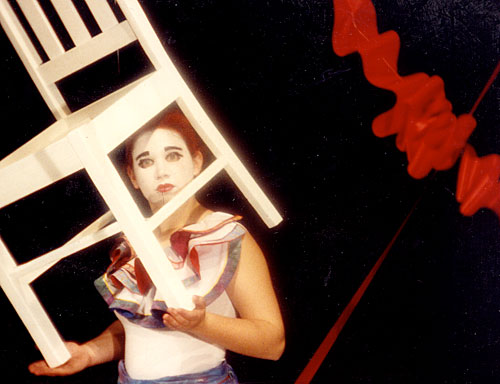
I created this image of ‘Egoity’, or the ‘self-aware’ individual, to illustrate a paper I wrote about the uniqueness of art knowledge and its importance in education when I was studying for my Masters in 1991. The paper delved into the difference between arts knowledge and other knowledge domains and posed the notion of a ‘genetic aesthetic’ or a pre-determined potential in all individuals for the development of imagination, creativity, perception and critical understanding.

I am inspired by Rosalie Gascoigne’s story—particularly because she had her first exhibition at 57—but also because she talked simply about her own practice and why she needed to work as an artist. Some of her quotes below confirm the idea of a genetic aesthetic, as she discusses her world and her inspiration in an ABC interview with Stephen Feneley in 1997 http://www.abc.net.au/arts/express/stories/rose.htm (sourced 24 February 2012)

Well, I used to walk out of the house and down the hill and round the place and I came to the conclusion that well nature was a friend anyway and something I knew about. As Picasso said once, you’ve got to start with what belongs to you, and that belonged to me because I knew about that. Nobody was going to tell me.

your eye gets sharpened, you get an expanding universe which I think every artist is after, otherwise they dry up which is a bad word in artistic life.

[So you were very conscious of this idea of not being able to draw?]

Oh very very. I couldn’t do anything, that’s why I think you stand there, and there’s the empty space and whatever poor talents you’ve got, you put something in it. But you’ve got the need you see, you’ve got the need, you’re going to find a way.

[Did you become an artist or did it just take you a long time to realise you were one?]

I didn’t ever become one, I was one. I was that sort of animal, no credit to you. It’s just you’re that sort of animal and it takes you a long time to find out what you really are and if nothing else is really offering, that truth seeps in pretty rapidly.