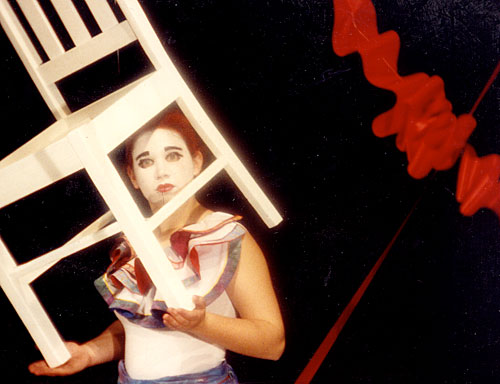
First video foray

1992, and Donna Wijngaart and I decided to make our first dance video. Of course neither of us knew much about making a video, but that would never stop us. I was studying dance on film and Donna was studying sculpture/performance. Anyway, we decided to collaborate. This work was to become the practical exploration for a paper I was writing where I proposed that to effectively make dance films, the choreographer had to understand and make major directorial and design decisions. If not, the work likely lacked coherence in its resolution of dance, design and film media.

I am really proud of this work. Donna did enter it in one of the Metro award seasons and won. But beyond that it wasn’t half bad for our first attempt, and spurred us both on to make other films.

We had plenty of other people contributing – Chris, Lara, Tasha and Danielle were all there and never forgetting Daniel La Forest who did the edit for us in my loungeroom, overnight, so that we could meet our respective assignment deadlines. Daniel also then set us up with our own analogue video editing equipment which provided many hours of fun, frustration and exhaustion.

We learnt a lot about what not to do in using effects on film, but it was pre-digital, so it was timely.

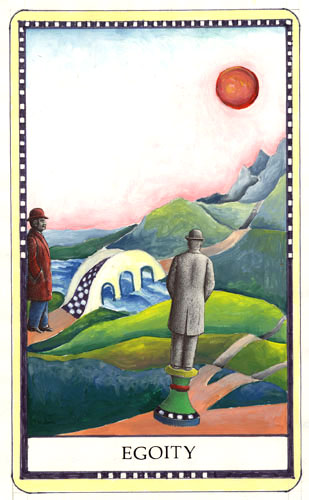
‘Egoity’ and Gascoigne

I created this image of ‘Egoity’, or the ‘self-aware’ individual, to illustrate a paper I wrote about the uniqueness of art knowledge and its importance in education when I was studying for my Masters in 1991. The paper delved into the difference between arts knowledge and other knowledge domains and posed the notion of a ‘genetic aesthetic’ or a pre-determined potential in all individuals for the development of imagination, creativity, perception and critical understanding.

I am inspired by Rosalie Gascoigne’s story—particularly because she had her first exhibition at 57—but also because she talked simply about her own practice and why she needed to work as an artist. Some of her quotes below confirm the idea of a genetic aesthetic, as she discusses her world and her inspiration in an ABC interview with Stephen Feneley in 1997 http://www.abc.net.au/arts/express/stories/rose.htm (sourced 24 February 2012)

Well, I used to walk out of the house and down the hill and round the place and I came to the conclusion that well nature was a friend anyway and something I knew about. As Picasso said once, you’ve got to start with what belongs to you, and that belonged to me because I knew about that. Nobody was going to tell me.

your eye gets sharpened, you get an expanding universe which I think every artist is after, otherwise they dry up which is a bad word in artistic life.

[So you were very conscious of this idea of not being able to draw?]

Oh very very. I couldn’t do anything, that’s why I think you stand there, and there’s the empty space and whatever poor talents you’ve got, you put something in it. But you’ve got the need you see, you’ve got the need, you’re going to find a way.

[Did you become an artist or did it just take you a long time to realise you were one?]

I didn’t ever become one, I was one. I was that sort of animal, no credit to you. It’s just you’re that sort of animal and it takes you a long time to find out what you really are and if nothing else is really offering, that truth seeps in pretty rapidly.